Stop Treating AI Like a Magic Wand for Broken Processes
Indigo Tech Foundry
- AI Automation

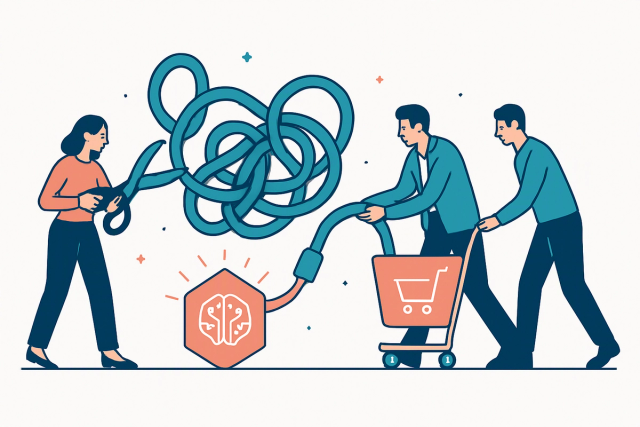
Most Hong Kong businesses rushing into AI workflow automation are trying to automate chaos, and the results predictably disappoint. The technology works, but it cannot fix a process that nobody has properly mapped out. Indigo Tech Foundry builds apps, websites and AI tools for Hong Kong businesses and offers a free 30-minute consultation, and the first thing we tell clients is that AI is not a magic wand for broken operations.
A typical scenario: a property agency wants an AI agent to handle tenant enquiries, but their lease terms live in three different WhatsApp groups, a shared spreadsheet last updated in 2022, and the memory of a senior agent who left last month. Feeding that mess into a large language model just produces confident hallucinations at scale. Before any document automation or bilingual AI assistant makes sense, someone has to decide what the canonical answer actually is and where it lives.
The same pattern appears in e-commerce. A retailer asks for an AI chatbot to recommend products, yet their Shopify catalogue uses internal codes like "SKU-889-BLK" instead of "women's black cotton t-shirt size M". Structured product data is what lets AI assistants such as ChatGPT, Gemini or Copilot find and recommend items. According to Shopify, merchants who clean up titles, descriptions and variant data see better discovery in AI search surfaces. The automation layer only works when the data layer is ready.
Document processing is where the gap shows up fastest. Teams imagine uploading a pile of PDFs and getting perfect structured data back. In practice, the system achieves over 90 percent accuracy only when document layouts are consistent and field definitions are clear. A human review step stays essential. The 30 minutes of manual entry per document drops to around 30 seconds, but only after the templates are standardised and the edge cases are agreed. Skip that preparation and you trade typing errors for verification bottlenecks.
Integration points are the other blind spot. An AI workflow that logs leads into a CRM, triggers a follow-up message and updates a spreadsheet sounds clean on a slide deck. In reality, the CRM might be Odoo, the messaging tool might be WhatsApp Business API, and the spreadsheet might have merged cells that break the sync. Each connection needs a defined schema, error handling and an owner who watches it. The leanest solution often starts with just one high-volume, low-variance task, invoice data entry, for example, and expands from there.
Cost of running the model is another factor that surprises teams. Token usage adds up when every incoming email triggers a full prompt with company context. Caching frequent answers, routing simple queries to rule-based logic, and keeping the human in the loop for exceptions keeps the monthly bill predictable. The goal is not to replace every human touch but to hand off the repetitive, rule-based work so the team can focus on negotiations, relationships and exceptions that actually need judgement.
The practical path forward: pick one workflow that burns the most time, map every step on a whiteboard, standardise the inputs, then build the smallest automation that removes the bottleneck. Measure the change, then repeat. Indigo Tech Foundry starts with a free 30-minute consultation to identify that first candidate. Book it at indigofoundry.app/enquiry or email enquiry@indigofoundry.app and we will walk through the map together.